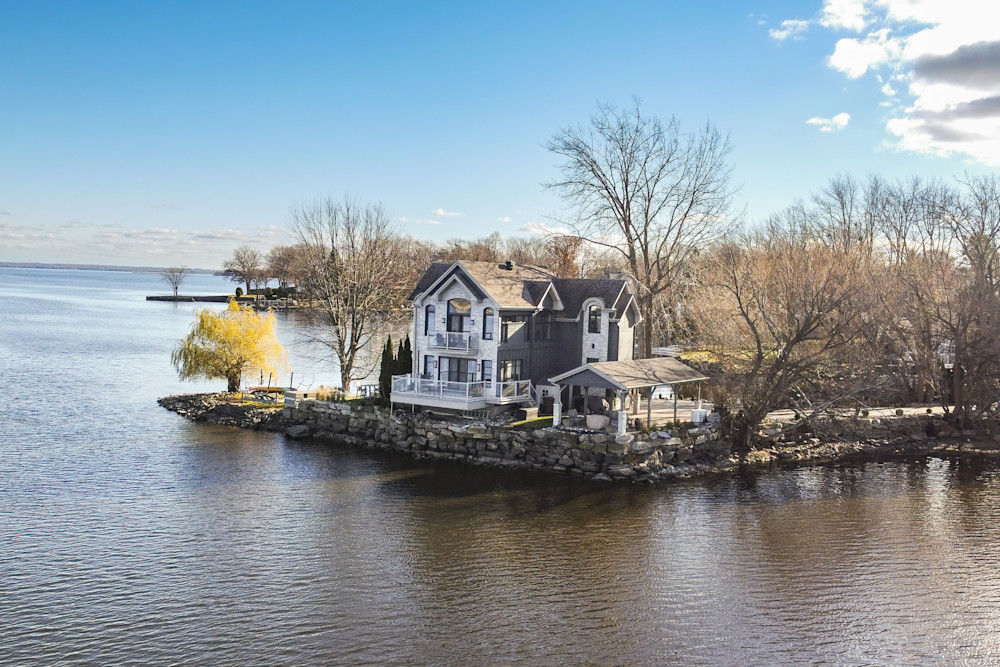
Sailboats tack across Lac des Deux Montagnes while Main Road unfolds at a quieter register — the Village Theatre in its century-old station, Greenwood Centre's stone walls holding centuries of stories, the weekly rhythm of market days and theatrical productions. This is Hudson at its most characteristic: composed, unhurried, and deeply tied to its setting. A village that has remained a village, where the Ottawa River defines the rhythm and daily life unfolds with a certain deliberateness. For those considering Hudson, Quebec real estate, it offers something increasingly rare — countryside living shaped by culture rather than convenience.

This is Hudson at its most characteristic: composed, unhurried, and deeply tied to its setting. A village that has remained a village, where the Ottawa River defines the rhythm and daily life unfolds with a certain deliberateness. For those considering Hudson, Quebec real estate, it offers something increasingly rare — countryside living shaped by culture rather than convenience.
Hudson sits 60 kilometres west of Montreal, where suburban sprawl finally gives way to farmland and forest. The town stretches along the lakeshore, a linear settlement that formed in the early 19th century when English and Scottish families established estates along the water. That anglophone heritage persists — Hudson remains roughly 65 percent English-speaking, a linguistic island in predominantly francophone Vaudreuil-Soulanges.
But what defines Hudson today is less about language and more about landscape: 2,162 hectares, more than half zoned agricultural, where horses graze in paddocks visible from Main Road and density rarely exceeds village scale. Development is measured, setbacks are generous, and the land continues to lead.
Why People Choose Hudson
Hudson offers an alternative to Montreal or the West-Island — not in opposition, but in contrast. The shift is less about distance than about tempo: a slower, more considered pace where space is not excess, but intention.

The village core remains intact rather than curated. Independent shops, cafés, and cultural institutions shape daily life without overstatement. The Hudson Music Festival draws audiences annually. The Village Theatre, Quebec’s oldest continually operating amateur company, mounts productions year-round. The Hudson & Region Studio Tour opens dozens of artist studios each autumn. Greenwood Centre hosts Storyfest, a literary festival. The Hudson Film Festival, affiliated with TIFF, screens Canadian cinema.
For a town of 5,400, the cultural presence feels unusually coherent. It is not driven by scale, but by continuity — a shared understanding of place that has developed over time rather than being imposed.

The distance from the city is part of the equation, but rarely the reason. Hudson attracts those seeking clarity — a place where time, space, and attention are more deliberately allocated. It occupies a specific position in the region: not fully rural, not suburban, but something more intentional in between.
The Shape of Hudson Real Estate
Along the waterfront, turn-of-the-century Victorian and Edwardian homes recall an era when Montrealers arrived by steamboat, drawn to the lake. These properties remain generous in scale, often set directly on the water, defined by proportions and details that resist replication.
Elsewhere, older stone houses — some dating back to the French colonial period — sit quietly within the landscape. These rarely trade hands, and when they do, they appeal to buyers drawn as much to provenance as to property.

Beyond the waterfront estates, Hudson’s housing stock becomes more understated. Mid-century homes and modest structures sit on expansive lots — half-acre to full-acre properties where the relationship between house and land takes precedence. For buyers exploring houses for sale in Hudson, Quebec, this sense of placement — homes within landscape rather than imposed upon it — often becomes the deciding factor.
New construction exists but remains limited. Agricultural zoning and heritage protections constrain development, preserving continuity while keeping inventory tight. Properties move quickly with buyers relying on timing, relationships, and expert local guidance — understanding which streets flood, which properties have true lake access, and which homes require septic versus municipal services.

The Village and Beyond
Hudson’s Main Road functions as the village spine. Independent shops, cafés, galleries, and the Sunday farmers’ market create a walkable core that feels intact rather than constructed.
The Willow Inn, housed in an 1820 colonial manor, offers dining with views of the Oka ferry crossing. St. James’ Anglican (1842) and St. Mary’s Anglican (1866) anchor the streetscape, their stone construction reinforcing the town’s architectural continuity.

Beyond Main Road, the town unfolds in quieter pockets. Hudson Heights, perched above the Ottawa River, offers elevated views and larger estates. Como, at the eastern edge, retains traces of its earlier identity as a lakeside destination. Alstonvale and Choisy, further west, transition into a broader agricultural landscape where neighbouring Saint-Lazare begins.
Nearby municipalities provide contrast. Saint-Lazare offers newer construction and more suburban infrastructure. Vaudreuil-Dorion provides retail and services Hudson lacks. But Hudson occupies a narrower lane — less oriented toward expansion, more defined by what it chooses not to become.
What It’s Like to Live Here
Hudson life unfolds at a different tempo. Weekdays may involve commuting, though remote work has made the town newly viable for those who no longer need daily access to the city. Weekends tend to centre on the lake — sailing at Hudson Yacht Club, paddling at Jack Layton Park, or walking the shoreline that connects Como to Hudson Heights.

The town runs on participation. The Hudson Historical Society operates a museum. The Hudson Players Club casts and produces shows. Community events — the Street Fair, Shiverfest, the St. Patrick's Day Parade — rely on resident involvement rather than municipal scale.
This creates a particular social dynamic. Hudson rewards presence. It is a place where engagement leads naturally to familiarity, and where community is built through shared activity rather than proximity alone.
The commute remains Hudson’s defining compromise. For some, it is prohibitive. For others, it is a measured trade-off — exchanged for space, quiet, and a degree of separation that allows for focus.

What Shapes Hudson
Hudson is not in the process of becoming something else. It is not being reshaped or rebranded. The village today closely resembles what it was decades ago — not static, but deliberate in its evolution.
In a region where development pressure continues to reshape surrounding areas, Hudson has maintained its boundaries. Agricultural zoning protects open space. Heritage restrictions preserve character. Growth, when it occurs, is incremental.
For buyers exploring Hudson, Quebec real estate, the appeal lies in that continuity. It is a place chosen deliberately — not for what it promises, but for what it consistently delivers: space, landscape, and a way of living shaped by intention rather than necessity. Understanding houses for sale in Hudson requires local insight — from waterfront access and flood zones to municipal services and septic systems. At M sur Main, in the heart of the village, that knowledge informs every transaction.